

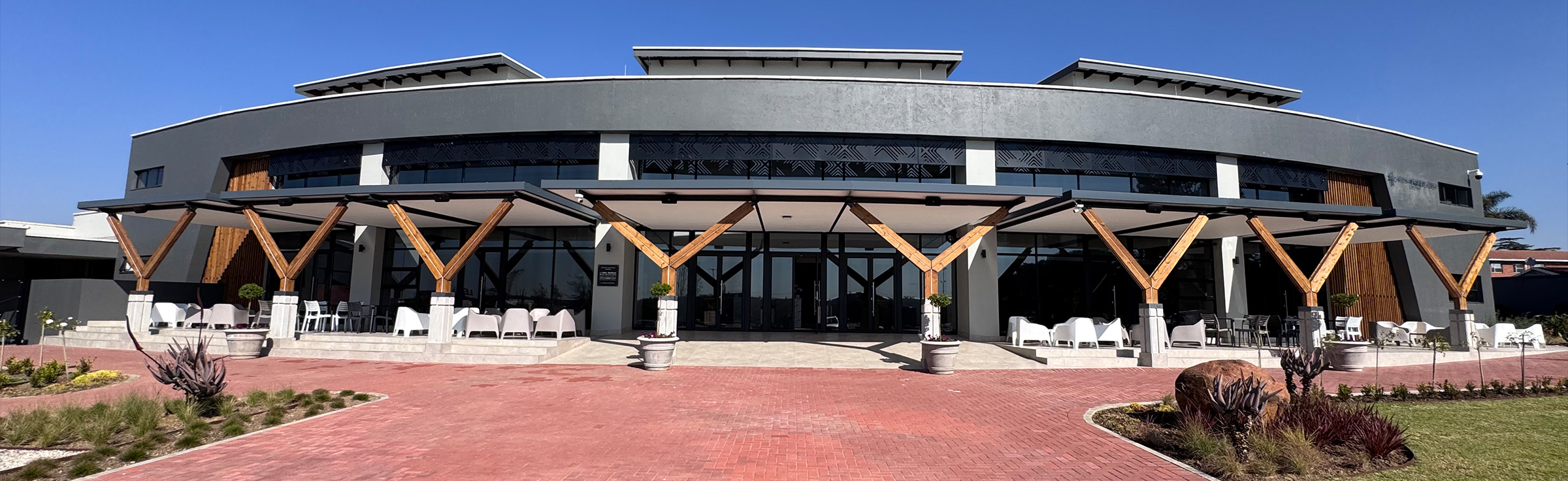
Pro AVL MEA on Christian Family Church South: a new campus built to share one live service with the church’s main home, several kilometres away.
Built from the ground up, Christian Family Church South has been designed to do more than host services of its own, operating as part of a single live service shared with the church’s main home several kilometres away.
AV technology has made worship more accessible than ever, allowing individuals to tune into weekly services from their own homes. It is communal in theory, and enables more people to take part in proceedings they otherwise could not, but is it truly collaborative?
This question was front and centre when Christian Family Church set out to construct a new satellite campus in South Johannesburg. The objective was not simply to reproduce a service taking place elsewhere, but to create a live, bidirectional connection through which pastors, worship leaders and production teams could participate from either location. A speaker could address both congregations from one campus during the first morning service, travel to the second and reverse the arrangement for the next. Musicians at one site could perform with feeds originating at the other, while camera feeds allow each congregation to see the worship taking place across the link.
The blank canvas provided a rare opportunity to approach the entire project as a single ecosystem encompassing the 750-seat auditorium, production facilities, foyer, multipurpose rooms and children’s spaces.
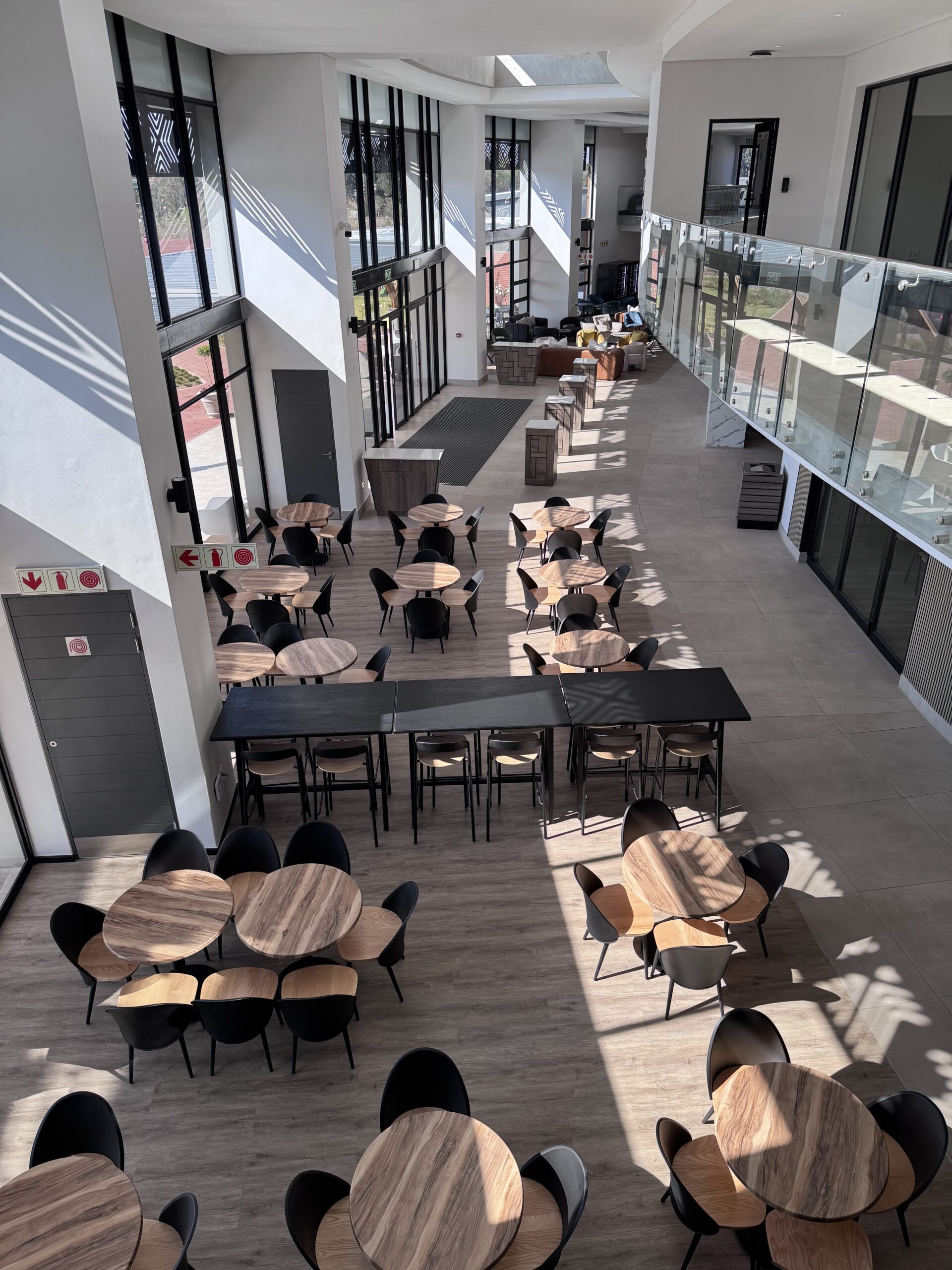
Q-SYS audio and control extend beyond the
auditorium into the foyer and other shared spaces
The process began with a competitive tender issued to several of South Africa’s major distributors and integrators. Each submitted a proposal before being invited to demonstrate its proposed sound system in one of the church’s existing venues.
Stage Audio Works (SAW) ultimately came out on top. “The process was incredibly fair and well thought out,” recalls SAW’s Kieren Hempel. “It gave everyone an equal opportunity to represent themselves as well as the products they were putting together. It also gave some life to the numbers and names on a piece of paper.”
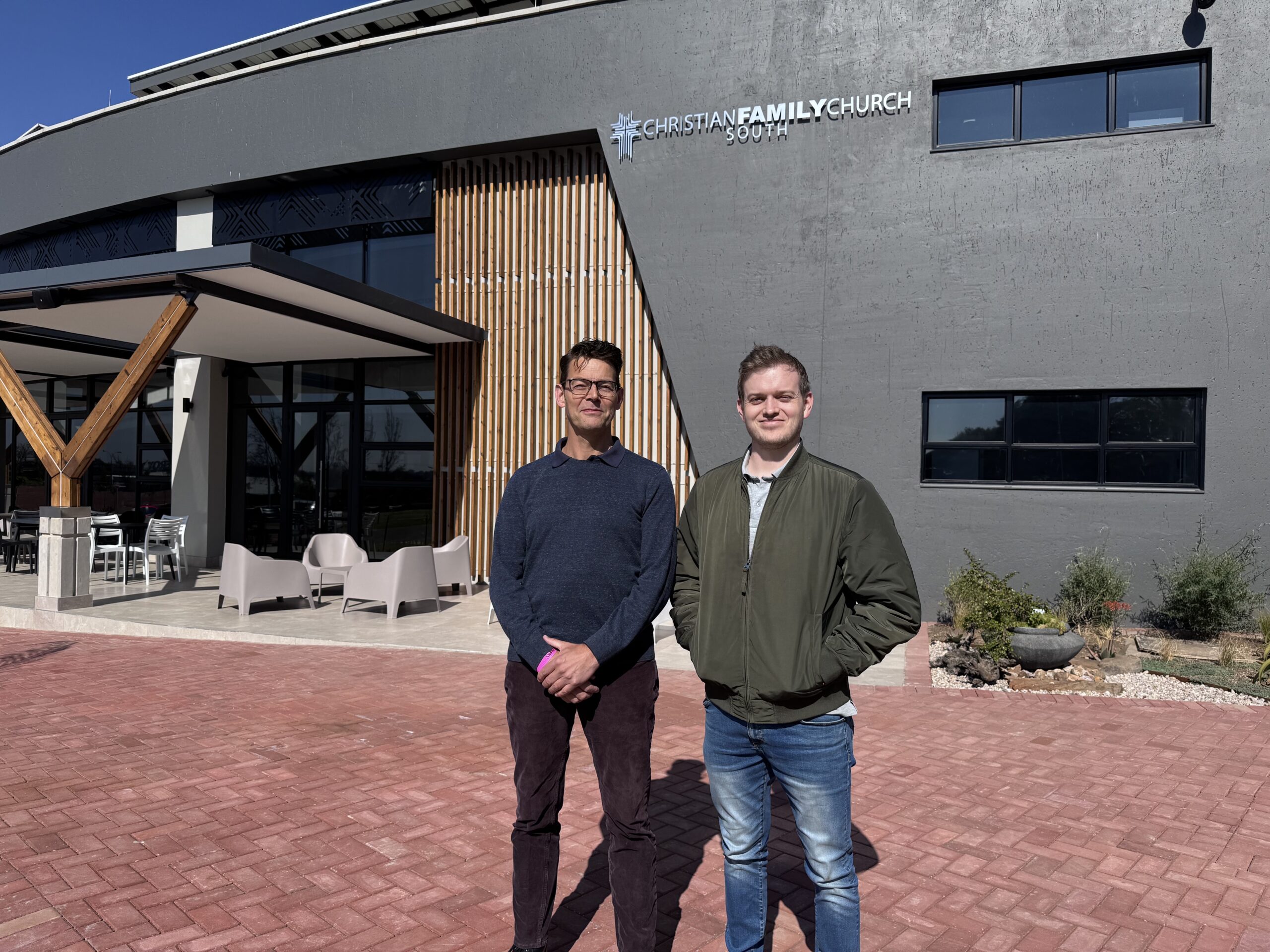
L–R: SAW’s Pieter van Hoogdalem and Kieren Hempel
outside Christian Family Church South
For the church, two requirements stood above the rest: audio quality inside the auditorium and the ability to deliver a point-to-point livestreaming system. The latter represented a significant departure from its previous approach. Although services had been streamed online, this would be its first dedicated link created to exchange live production feeds between campuses.
As discussions expanded into lighting, video distribution, room control and the outlying spaces, it was determined that appointing separate contractors for each discipline risked producing a collection of individual systems rather than a unified environment.
“The church was keen to appoint one person to do a turnkey solution rather than have lighting from one and audio from another,” says Hempel. “The goal was to create a cohesive system that could all be brought into one, whether that was through a touchpanel, a sound desk or Q-SYS.”
With initial conversations taking place approximately 12–13 months before the campus opened, the original scope remained largely intact. The main challenge was coordinating the many direct contractors working towards the same opening date, each with a different route to completion. Early involvement nevertheless allowed the integrator to coordinate the underlying infrastructure while the building itself was taking shape.
At the heart of the project is the link between Christian Family Church South and the main campus. Matrox Monarch Edge E4 encoders and Monarch Edge D4 decoders at both locations carry four discrete video channels and 16 channels of audio over a Layer 2 connection, with network routers installed at either end. The main campus also upgraded its production switching as part of the project to a Blackmagic Design ATEM Constellation 4 M/E.
The church specifically wanted a low-latency live link rather than a scheduled or time-shifted programme. The system therefore needed to support interaction within a service, not merely deliver a recording from elsewhere. SAW worked closely with the internet provider early in the project to make this happen.
For worship, individual console buses including drums, tracks, click, guide and lead vocal can be passed between sites. The remote lead and supporting feeds are brought into one campus, where local musicians and vocalists perform alongside them. The arrangement remains directional during each segment, avoiding a return loop that would compound latency.
The same video infrastructure enables a worship leader at one location to appear on the screens at the other. Teams can choose from local cameras and incoming shots, placing a remote worship leader on the auditorium screen while the singers onstage provide backing vocals. Wide views of the congregation can also travel in either direction, letting worshippers see the service taking place at the other location.
Behind these public-facing elements, Hollyland 4-wire interfaces feed production comms into the Matrox link so that service producers can coordinate in real time. “Having real comms between campuses was a big thing,” says Hempel. “It keeps the communication flowing, allowing better coordination of the cross-site video/audio transition.”
The church’s service workflow begins well before Sunday morning. Teams rehearse across the connection on Wednesday evenings, providing both a creative run-through and a test of the complete path. Tracks, remote camera sources and inter-campus communications must all meet at the correct point in the service, yet much of this complexity has been kept behind the interfaces presented to operators.
This is particularly important where experienced technicians work alongside volunteers still developing their production skills. “What jumps out for me is that technology now allows something technically complex to be managed easily and intuitively through interfaces like Companion/Stream Deck and Q-SYS,” says Hempel.
SAW spent time onsite during commissioning and returned for follow-up training once the team began using the equipment in live services. “You only find out what you don’t know when you start operating the equipment, even after you have gone for training,” he acknowledges.
Simplicity did not mean delivering part of the system and promising to finish it later. Hempel is emphatic that there should be no “phase two” for essential coverage or functionality, as new demands quickly begin competing for funding once a church opens. “Whatever part of the audio, video or lighting we are doing, it has to be complete,” he says. “On opening Sunday, you can’t have part of the congregation sitting in a shaded area, audio-wise.”
This philosophy is encapsulated in SAW’s internal motto: “Everyone can see and everyone can hear.” If a premium solution cannot be deployed completely, Hempel would rather specify a more economical system that covers the entire requirement than preserve a prestigious name on only part of the project.
The auditorium PA provides a clear example. Rather than follow the widespread preference for compact line arrays in contemporary worship spaces, where the ceiling doesn’t allow for a long enough array length, SAW proposed a distributed d&b point-source design. The church imposed no preferred format, but required every supplier to demonstrate its proposed system.
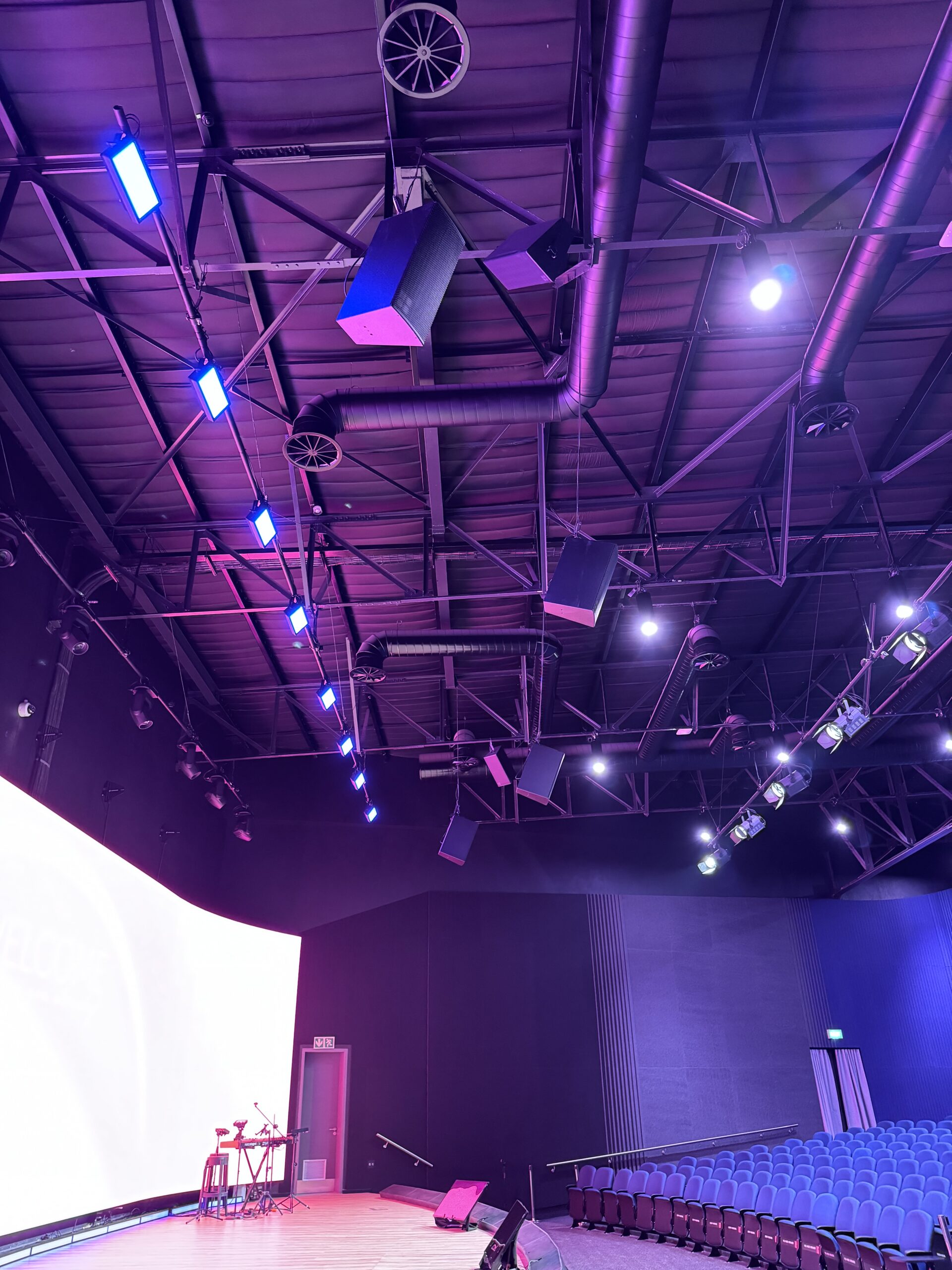
The auditorium uses a distributed d&b point-source
system rather than a conventional line array
The final design uses four Vi7P point-source loudspeakers, supplemented by six discreet 44S frontfills and a central pair of B22 subwoofers. On paper, the deployment appears relatively straightforward. Hempel argues, however, that the engineering and pattern control behind the Vi7Ps are more important than the visual complexity of the array. “There is much better control from a very well-engineered point source than from a poorly specified line array,” he says. “The gain before feedback onstage is phenomenal.”
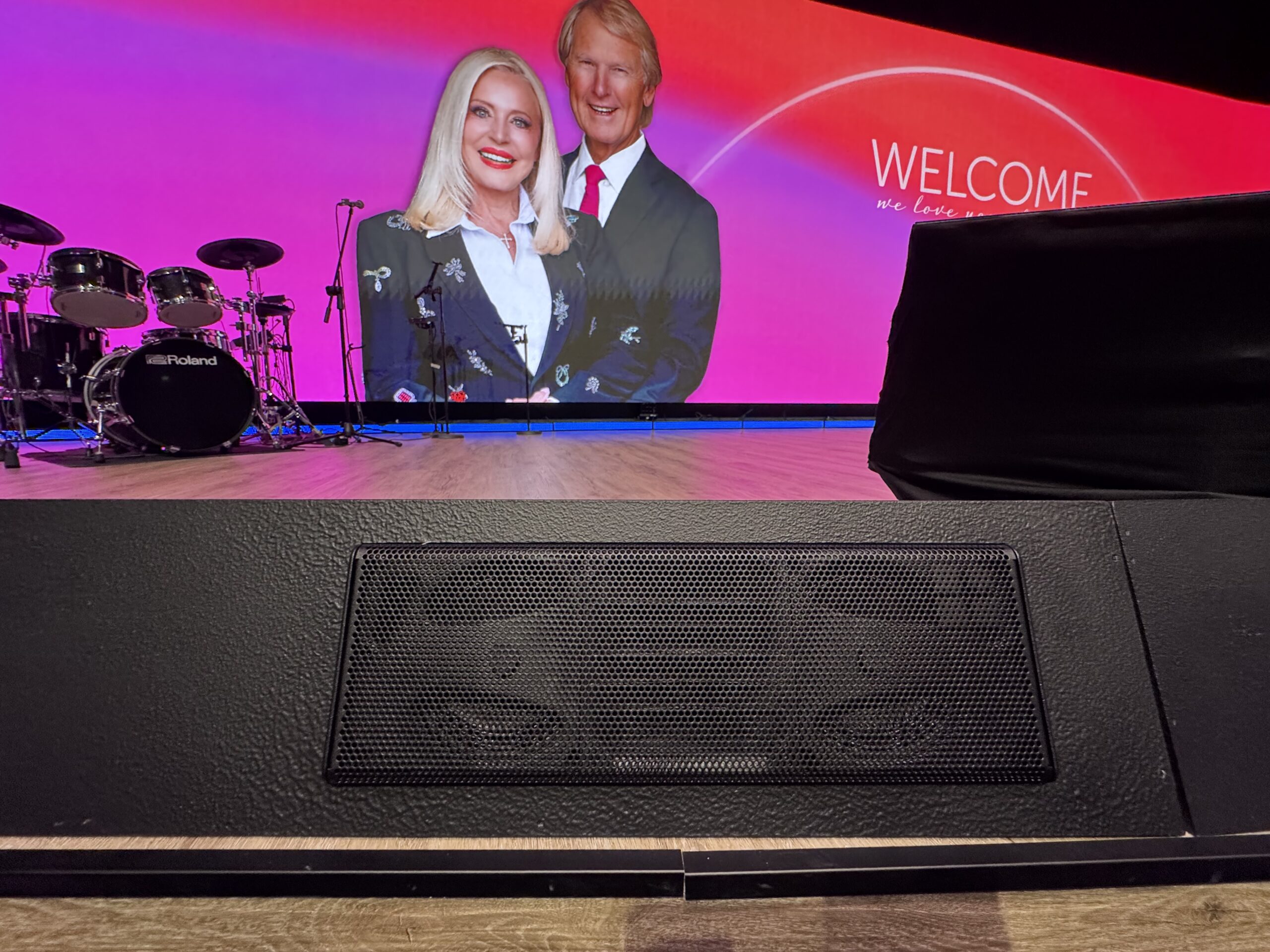
A discreet d&b frontfill is integrated into
the stage edge beneath the LED wall
The shape and scale of the auditorium suited the point-source approach, while the loudspeakers’ controlled dispersion helped SAW address the proximity of neighbouring properties behind the venue. “We’re big on choosing the right box for the space,” Hempel continues. “The PA system and the room are synonymous with each other; they interact with each other.”
From the church’s perspective, this was supported by the demonstration process. Rather than approving a system from drawings and hearing it only after installation, leaders could compare the proposed solutions in a familiar environment. The result is an audio system selected for the room and its operating requirements rather than for fashion or appearance. Acoustic treatment has created a controlled but not excessively dead room, while SAW also supplied the backline, including an electronic drum kit chosen to manage stage volume. Mixing is performed on a Waves eMotion LV1 Classic, with Sennheiser EW-D digital wireless microphones forming part of the stage package.
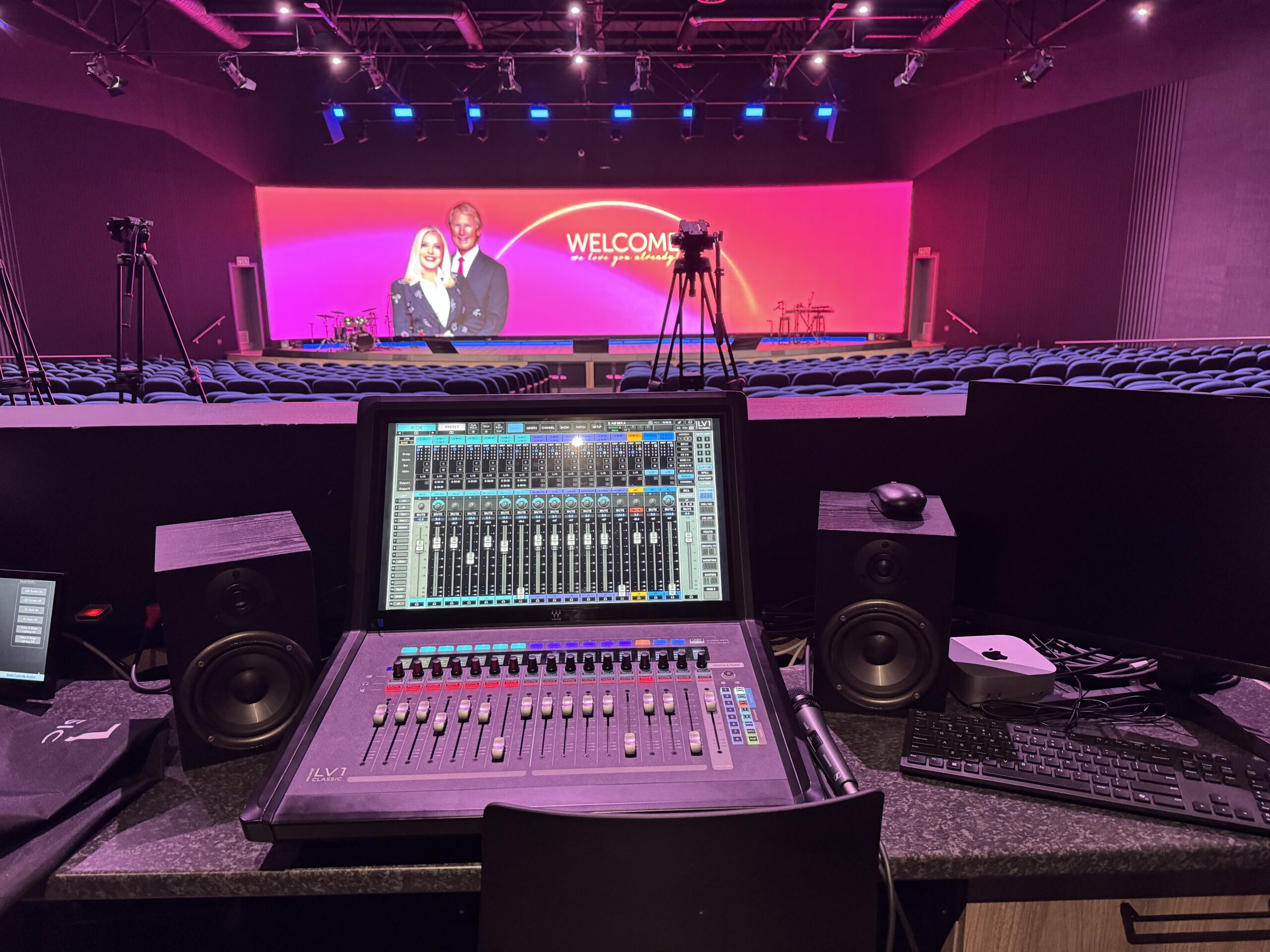
A Waves eMotion LV1 Classic at FOH
overlooks the 750-seat auditorium
The auditorium’s visual focus is an 18m x 4m (WxH) PixelPlus LED wall boasting a 2.6mm pixel pitch. Rather than install separate IMAG displays either side of a central graphics screen, the team chose one continuous surface with a gentle curve towards its outer edges.
Live cameras can appear as picture-in-picture windows at the upper corners, or a remote presenter can occupy a large central 16:9 frame with scripture and graphics around the image. Resolume runs on a custom PC with an Nvidia GPU, feeding the wall through two synchronised 4K outputs, forming a single LED screen canvas.
Lighting carries the visual treatment into the room. Front lighting is provided by Plus Lighting SP350 Fresnels, with eight ACME Voltkas used for wash and strobe effects alongside 16 ACME Pixel IP pixel bars and eight ACME Willow 500 moving fixtures. The Plus Lighting RGBW house lights are also integrated into the system, with all lighting controlled from an MA Lighting Command Wing.
Beyond the auditorium, a Q-SYS Core 24f processor distributes audio and control throughout the foyer, children’s areas, reception and multipurpose room. Audio in these spaces is reinforced from a selection of wall-mounted Audac cabinets. A wall-mounted interface in the foyer can control sources and dim the lighting, while the multipurpose room can operate independently or receive a feed from the auditorium. Dante networking replaces traditional analogue consoles and multicore cabling in secondary spaces via Plus Audio Dante-to-analogue converters.
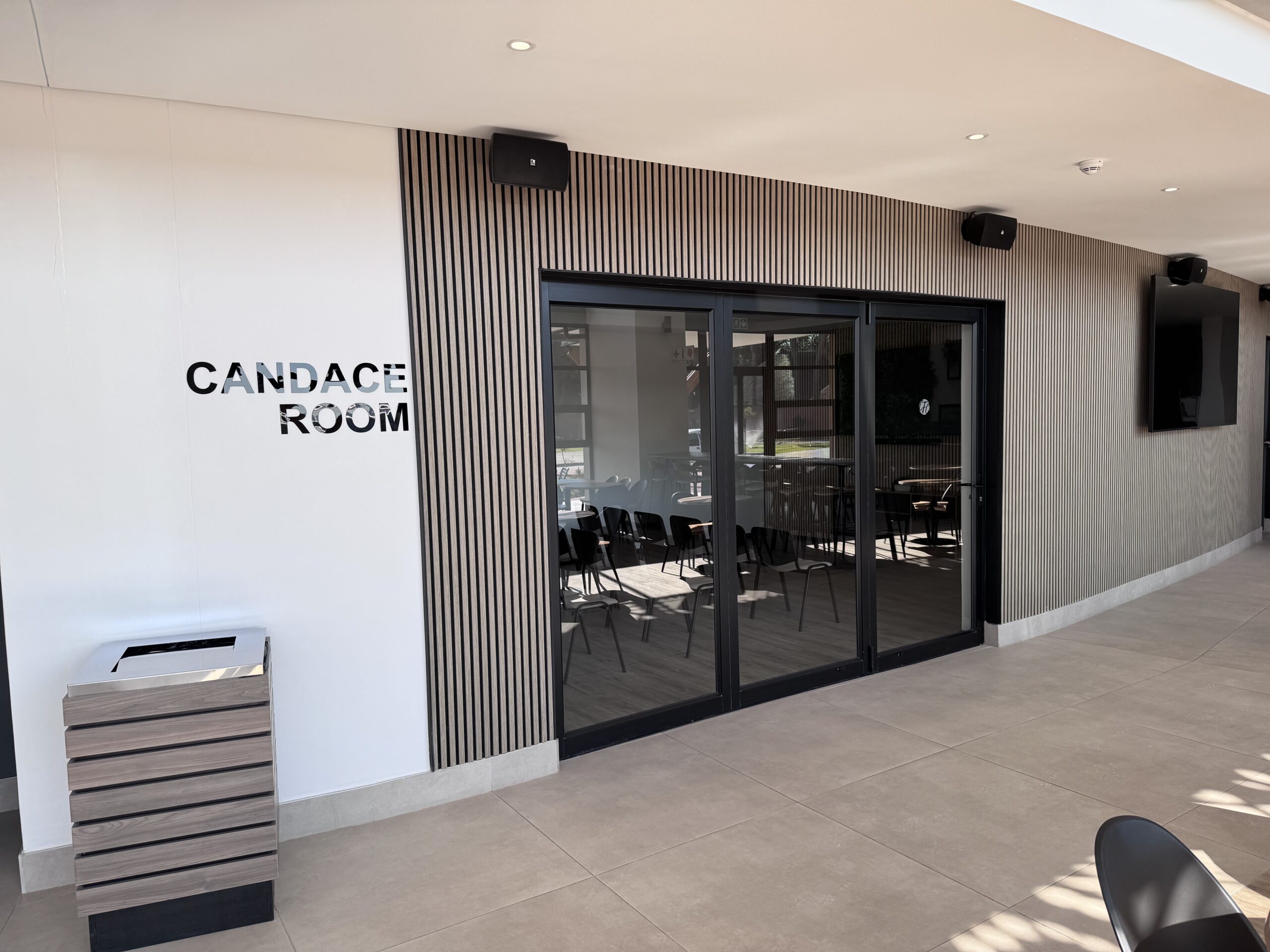
Audio is distributed outside the auditorium
via Audac wall-mounted cabinets
The intention is not to expose every technical possibility to every user. Each area instead receives the controls needed for its purpose. That simplicity depended on early coordination. Infrastructure spanning lighting, networking, video, audio and control cannot easily be added at the eleventh hour without compromise; here, the new-build programme allowed the relevant pathways and interfaces to be considered from the outset.
Christian Family Church South may be a brand-new building, but its real achievement lies in making it part of a much larger whole. By treating networking, communications, production and worship as one ecosystem rather than separate disciplines, SAW has delivered a campus designed not simply to host services, but to erase the boundaries between them.
First published by Pro AVL MEA. Read the original article
About Stage Audio Works
Stage Audio Works is a leading provider of professional audio, video, lighting, staging and media technology solutions across Africa. The company delivers innovative products, technical expertise, training and support to the live events, broadcast, worship, education, corporate and commercial integration markets.
READY TO START
SOMETHING GREAT?
GET IN TOUCH
Johannesburg Office
T: +27 (0) 87 55 10 100
F: +27 (0) 11 568 4973
22 Kyalami Boulevard, Kyalami Park,
Midrand, 1684, South Africa
Namibia Office
T: +264 83 33 10 100
F: +264 83 33 10 114
Mindeco Park, 9 Faraday Street,
Southern Industrial, Windhoek, Namibia